
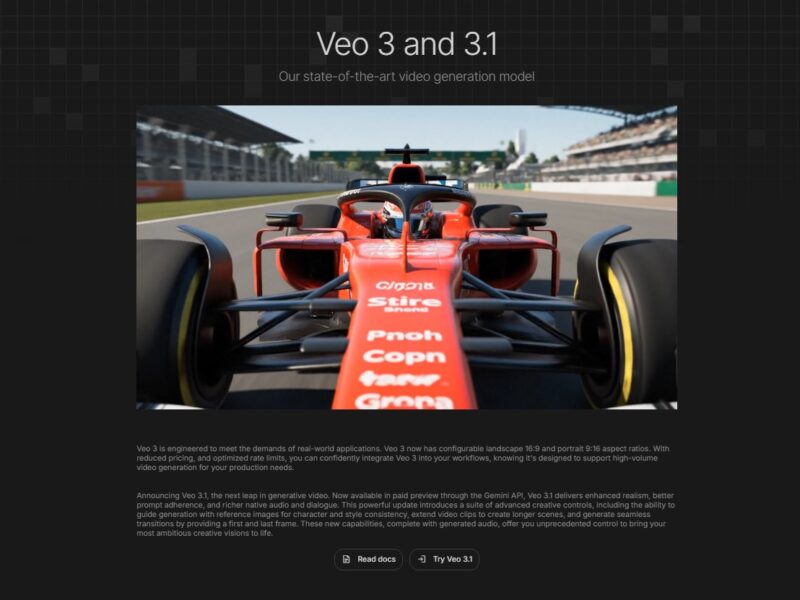
Google Veo-3
What is VEO-3?
VEO-3 is an advanced video understanding model developed by Google AI Studio. It is designed to analyze, interpret, and generate insights from video content, offering a robust framework for improving tasks such as video classification, scene understanding, and event recognition. By leveraging deep learning and computer vision, VEO-3 aims to provide more sophisticated video processing capabilities, making it ideal for businesses, researchers, and content creators looking to extract meaningful insights from video data.
VEO-3 is part of Google’s ongoing efforts to push the boundaries of AI in the realm of video, offering users the ability to automate and enhance video processing workflows with high accuracy and efficiency. It provides tools that simplify video analysis for a wide range of applications—from content moderation to marketing analysis.
Features
-
Advanced Video Analysis
VEO-3 utilizes state-of-the-art deep learning models for comprehensive video analysis. It can recognize and classify various elements within a video, such as objects, people, actions, and scenes. This makes it an ideal tool for industries that require in-depth video data processing, such as security, media, and entertainment. -
Contextual Understanding
One of the standout features of VEO-3 is its ability to interpret video content in context. This means it can not only identify objects but also understand their relationship within a scene. For example, it can distinguish between a person playing a sport and a person simply standing still, providing more accurate insights. -
Real-Time Processing
VEO-3 supports real-time video processing, allowing users to analyze live video feeds and generate actionable insights on the fly. This is particularly useful for industries like surveillance and live broadcasting, where immediate feedback is essential. -
Multi-Modal Capabilities
VEO-3 combines multiple forms of AI, including computer vision, natural language processing (NLP), and audio analysis. This allows the model to provide a holistic understanding of video content by incorporating both visual and auditory information, which is valuable for applications like automated content tagging or sentiment analysis. -
Customizable Models
Users can fine-tune VEO-3 for specific use cases. Whether you need the model to focus on detecting certain objects or analyzing particular actions, VEO-3 provides the flexibility to adjust the model’s parameters according to specific business or research needs. -
Scalable and Cloud-Based
Built on Google Cloud’s powerful infrastructure, VEO-3 is highly scalable, allowing users to process vast amounts of video data without worrying about performance limitations. This makes it a great option for enterprises dealing with large-scale video datasets. -
Seamless Integration with Other Google Tools
VEO-3 integrates well with other Google AI and Cloud services, such as BigQuery and Google’s TensorFlow. This allows users to easily incorporate video analysis into larger workflows, whether for data storage, processing, or visualization.
Pros and Cons
Pros:
-
High Accuracy: VEO-3 provides highly accurate video recognition, with the ability to identify and categorize objects, actions, and scenes with impressive precision.
-
Real-Time Processing: The ability to process video in real-time makes VEO-3 ideal for live video feeds, enhancing its utility in industries like surveillance and event broadcasting.
-
Comprehensive Model: VEO-3 combines vision, language, and audio understanding, offering a multi-dimensional approach to video content analysis.
-
Customization: The ability to fine-tune VEO-3 allows businesses and researchers to tailor the model to specific needs, enhancing its relevance and applicability.
-
Scalability: VEO-3’s integration with Google Cloud ensures that it can scale seamlessly to handle large datasets without compromising performance.
Cons:
-
Complexity: VEO-3 is a powerful tool, but it may require a certain level of expertise to effectively implement and integrate it into existing systems.
-
Cost: While the cloud-based solution is scalable, the cost of processing large volumes of video data can become significant, especially for enterprises with high data needs.
-
Dependency on Google Cloud: Being built on Google Cloud, VEO-3 may not be the best fit for businesses that prefer or require other cloud platforms or local solutions for their video data processing.
-
Limited Pre-Trained Models: While the model is highly customizable, it may require substantial training data to fine-tune it for specific use cases, which can be time-consuming and resource-intensive.
Use Cases for VEO-3:
-
Security and Surveillance
VEO-3’s ability to analyze video feeds in real-time makes it a powerful tool for security applications. It can automatically detect suspicious activities, recognize faces, and track moving objects, helping security teams monitor and respond more effectively. -
Content Moderation for Social Media
Content platforms can leverage VEO-3 for automated content moderation. By analyzing video uploads for inappropriate content, offensive language, or copyright violations, VEO-3 helps reduce manual moderation efforts and ensures a safer user experience. -
Automated Video Tagging and Search
VEO-3 can automatically tag videos with relevant keywords based on the content it detects. This is invaluable for content libraries and media companies looking to streamline video search, categorization, and recommendation systems. -
Market Research and Sentiment Analysis
Marketers can use VEO-3 to analyze customer reactions to video advertisements or product launches. By extracting sentiment from both the visual and auditory elements of videos, it provides deep insights into audience engagement. -
Healthcare and Medical Research
VEO-3 can assist in analyzing medical videos, such as diagnostic imaging or surgical procedures, by identifying critical moments, anomalies, or points of interest. This can improve medical workflows and assist in research by analyzing large video datasets.
VEO-3 Compared to Other Tools
VEO-3 vs. IBM Watson Video Analytics
Both VEO-3 and IBM Watson Video Analytics are designed for video analysis, but they differ in some key areas. While both offer real-time video processing and object detection, VEO-3 integrates seamlessly with other Google Cloud services, making it a more flexible option for businesses already invested in the Google ecosystem. IBM Watson, on the other hand, offers a broader range of AI services beyond video, which might be beneficial for enterprises looking for a one-stop solution.
VEO-3 vs. Amazon Rekognition
Amazon Rekognition is another powerful video analysis tool, offering object detection, facial analysis, and activity recognition. However, VEO-3 stands out with its multi-modal capabilities, combining computer vision with NLP and audio analysis, offering a more holistic approach to video content understanding. Additionally, VEO-3’s integration with Google’s AI tools like TensorFlow and BigQuery offers enhanced scalability for businesses working with large datasets.
VEO-3 vs. Microsoft Video Indexer
Microsoft Video Indexer offers video indexing, content analysis, and automated tagging. While both VEO-3 and Video Indexer offer comprehensive video insights, VEO-3’s real-time processing, multi-modal understanding, and tight integration with Google Cloud may provide a better fit for enterprises already using Google services. Video Indexer, however, may be a better choice for businesses already utilizing the Azure ecosystem.
VEO-3 from Google AI Studio is a game-changing tool for businesses, researchers, and content creators who need to analyze and interpret video content. With its advanced deep learning models, real-time processing, and multi-modal capabilities, VEO-3 offers a comprehensive solution for understanding video data across a range of industries. Whether you’re working in security, content moderation, marketing, or healthcare, VEO-3 provides the scalability, customization, and accuracy needed to unlock valuable insights from video content. While it does have some challenges, such as complexity and cost, its powerful features make it an invaluable tool for those looking to harness the full potential of video analytics.
FAQs
1. What is VEO-3 used for?
VEO-3 is used for advanced video analysis, including object detection, scene recognition, event detection, and sentiment analysis. It is applicable across various industries such as security, healthcare, entertainment, and marketing.
2. Can I integrate VEO-3 with my existing workflows?
Yes, VEO-3 integrates seamlessly with Google Cloud services such as TensorFlow and BigQuery, making it easy to incorporate into existing video data processing and analysis workflows.
3. How does VEO-3 handle real-time video processing?
VEO-3 is capable of processing video in real-time, allowing businesses to analyze live video feeds and generate actionable insights as events occur.
4. Is VEO-3 suitable for businesses with large-scale video data needs?
Yes, VEO-3 is designed to scale efficiently, making it ideal for enterprises with large volumes of video data. Its integration with Google Cloud ensures performance optimization, even with massive datasets.
5. What makes VEO-3 different from other video analysis tools?
VEO-3 stands out for its multi-modal approach, combining vision, language, and audio processing for a more holistic understanding of video content. Additionally, its integration with Google Cloud’s AI ecosystem makes it highly adaptable and scalable.