
GlassFrog
What is GlassFrog?
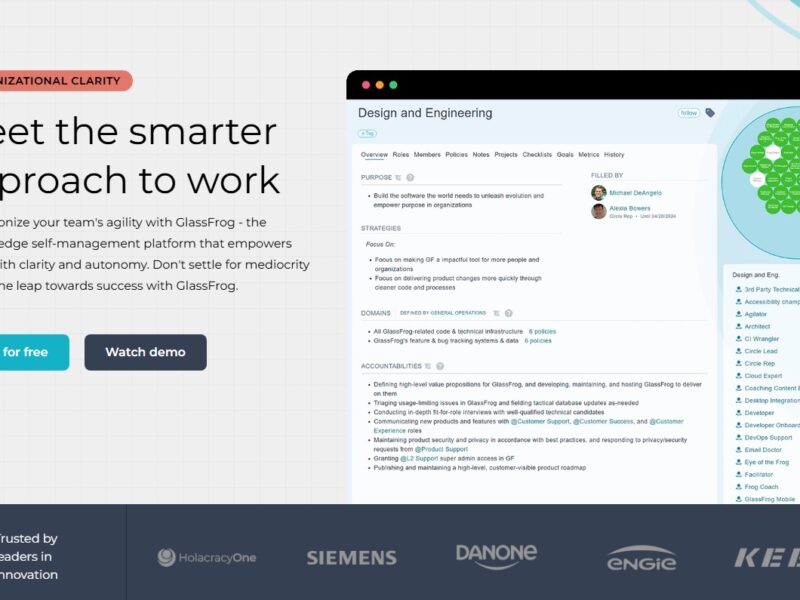
GlassFrog is a cloud-based team and organizational management platform designed to support self-managed work environments and modern governance practices. It provides structured tools for defining roles, responsibilities, policies, and decision-making processes, helping organizations move away from traditional hierarchical models toward clarity, autonomy, and agility. Originally tailored for practitioners of Holacracy, GlassFrog now supports a variety of decentralized work frameworks and team structures.
Key Features
GlassFrog includes a suite of features that help teams improve collaboration, governance, and operational clarity:
Organizational Clarity
-
Dynamic role and circle definitions that reflect real-time responsibilities.
-
Transparent organizational charts and access to roles, projects, and accountabilities.
Governance and Decision Tools
-
Tools for capturing, proposing, and processing governance changes.
-
Interfaces designed for structured governance and tactical meetings.
Meetings and Collaboration
-
Real-time meeting support with agile meeting workflows.
-
Asynchronous proposals and decision tracking outside of scheduled meetings.
Integrations and Support
-
Integrations such as Slack, Google SSO, API access, and more (varies by plan).
-
Multilingual support and customer assistance via email or live chat.
Advanced Add-Ons
-
OKRs and goal tracking with the Goals & Targets feature.
-
AI assistant (FrogBot) for helping users navigate policies and processes.
Pros & Cons
Pros:
-
Organizational Transparency
GlassFrog eliminates ambiguity around roles, accountabilities, and reporting structures. -
Structured Meeting Support
It streamlines governance and tactical meetings with built-in workflows. -
Scalable for Teams of All Sizes
Free plans support unlimited users, while premium plans expand capabilities. -
Facilitates Self-Management
Designed to support self-organizing teams and frameworks like Holacracy. -
Community and Support Resources
Good customer support and habit support programs help with adoption.
Cons:
-
Steep Learning Curve
New users may struggle with self-management terminology and workflows. -
UI and Navigation Challenges
Some users find certain features hard to navigate or not intuitive. -
Limited Project Visualization
The project board may lack flexibility compared to dedicated tools like Trello. -
Performance Issues
Some reviews report slow loading times under certain conditions.
Use Cases:
GlassFrog serves a variety of organizational needs, including:
-
Holacracy Implementation
Ideal for organizations adopting Holacracy or similar governance systems. -
Self-Managed Teams
Teams seeking autonomy with clear accountability use GlassFrog to define roles and responsibilities. -
Agile and Cross-Functional Teams
Agile teams use the platform to manage meetings, projects, and decisions collaboratively. -
Governance and Policy Tracking
Organizations that want transparent decision histories and change tracking benefit from its governance tools. -
Distributed or Remote Workforces
Remote teams gain clarity on roles and actions without relying on traditional org charts.
Compared to Other Tools
GlassFrog differs from conventional collaboration and project management tools in several ways:
-
Focus on Governance: Unlike general tools like Asana or Trello, GlassFrog emphasizes autonomous governance and role clarity within teams.
-
Self-Management Support: It is purpose-built for frameworks such as Holacracy, something not directly supported by mainstream tools.
-
Holistic Organizational Framework: GlassFrog combines decision-making, governance, and operational tracking in one platform rather than splitting these into separate apps.
-
Meeting Structure Integration: Many project tools support task tracking but lack deep integrations for structured governance meetings. GlassFrog addresses both.
GlassFrog is a specialized platform for organizations aiming to implement or enhance self-management and governance practices. Its strength lies in enabling clarity around roles, structured decision-making, and transparent workflows. While it may require a learning period and has some navigation limitations, GlassFrog remains a powerful choice for teams committed to autonomy, accountability, and agile governance. Especially suited for Holacracy practitioners and evolving self-managed teams, it stands apart from traditional task-centric tools by offering a governance-first approach to organizational effectiveness.
FAQs
1. Is GlassFrog free to use?
Yes. GlassFrog offers a free plan with essential features and up to 10 users, plus premium plans with additional capabilities.
2. What frameworks does GlassFrog support?
GlassFrog supports self-management systems, including Holacracy, Sociocracy, and other decentralized governance models.
3. Can GlassFrog integrate with other software?
Yes. It provides integrations such as Slack, API access, and SSO options.
4. Is GlassFrog suitable for small teams?
Yes. It can be used by teams of all sizes, though smaller teams should factor in the learning curve.
5. Does GlassFrog help with goal tracking and OKRs?
Yes, through add-on features like Goals & Targets, GlassFrog supports strategic goal tracking including OKRs.