
Forefront
What is Forefront?
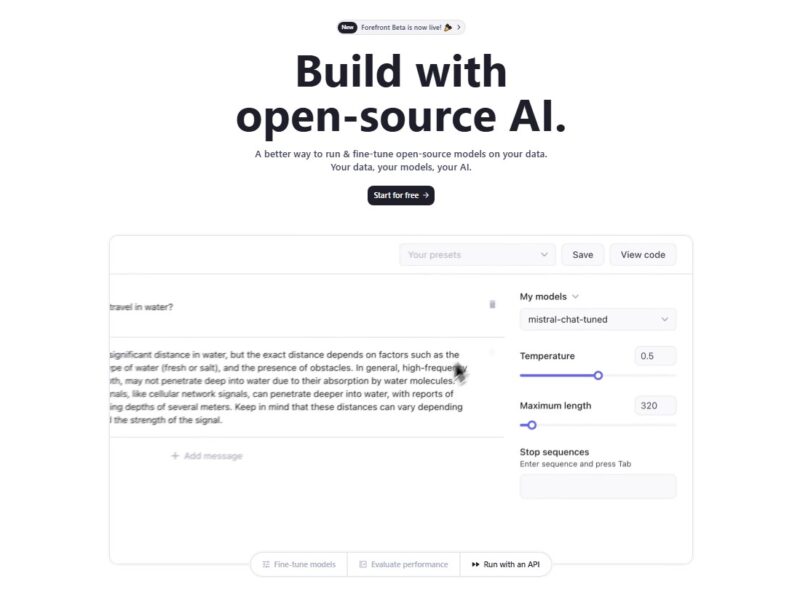
Forefront is an AI-focused technology platform designed to help developers and businesses build, fine-tune, deploy, and manage open-source and custom AI models. Rather than offering only pre-trained models or generic chatbot services, Forefront gives users deeper control over model customization, performance evaluation, data management, and API integration — enabling tailored AI solutions for a range of use cases from research to production-level applications.
Features
Forefront incorporates a comprehensive set of tools centered on AI development and deployment:
Model Fine-Tuning
Users can fine-tune leading open-source models using their own data to improve accuracy and relevance for specific workflows.
Deployment Infrastructure
The platform offers serverless API endpoints for chat, completion, and inference, allowing developers to deploy models without managing infrastructure.
Data Warehouse and Management
Forefront provides a centralized AI data warehouse to store and organize training, validation, and evaluation datasets.
Performance Analytics
Built-in evaluation tools — including loss charts and multiple benchmark tests — help assess model quality and behavior during training and deployment.
Model Export and Self-Hosting
Models can be exported for self-hosting or deployed with third-party providers, offering flexibility in how and where AI runs.
Scalable Infrastructure
Forefront automatically scales with demand, handling fluctuating workloads without requiring users to provision or manage GPU resources manually.
Privacy-Focused Architecture
The platform emphasizes data privacy by not logging inference requests or using customer data to train other models.
Pros & Cons
Pros:
-
Custom AI Control: Fine-tune models with private data to match niche applications.
-
Scalability: Serverless deployment adapts to traffic without manual configuration.
-
Integrated Data Tools: Centralized data warehouse simplifies data preparation and iteration.
-
Privacy-First Design: Claims not to log requests or use data for training external models.
-
Flexible Deployment: Supports API integration and export for self-hosting.
Cons:
-
Technical Learning Curve: Users without ML experience may need additional learning.
-
Cloud Reliance: The platform is cloud-based with no clear on-premises alternative.
-
Potential Cost: Advanced usage and high API traffic may require paid subscriptions.
-
Limited Consumer Chat Features: Some earlier consumer-facing chat interfaces have been deprecated as the platform pivots toward developer tools.
Use Cases:
Forefront supports a wide range of professional scenarios:
-
Custom AI Application Development – Build and fine-tune models for specific business or research tasks.
-
Enterprise AI Deployment – Deploy production-ready AI services with scalable infrastructure.
-
Content Automation – Generate natural language text, summaries, or structured outputs using tailored models.
-
Data Analysis and Insight Extraction – Use trained models to process and derive insights from large datasets.
-
AI-Enhanced Customer Support Tools – Integrate fine-tuned models into chatbots or support automation systems.
Compared to Other Tools
Forefront occupies a distinct position among AI development platforms:
-
Versus Pre-Built Chatbots: Platforms like standard AI chat services focus on conversational use cases, whereas Forefront centers on model customization and deployment at scale.
-
Versus Proprietary Model Providers: Compared to managed AI model providers, Forefront emphasizes open-source models and user control — giving development teams flexibility over how models behave and how data is used.
-
Versus Model Marketplaces: Model marketplaces offer ready-made models, but Forefront’s fine-tuning, performance evaluation tools, and data warehouse provide deeper integration and customization for bespoke workflows.
This blend of customization, privacy, and deployment flexibility differentiates Forefront from both consumer AI interfaces and traditional managed AI platforms.
Forefront is a robust platform for building, fine-tuning, and deploying AI models with a strong focus on developer control, data privacy, and deployment flexibility. It addresses common challenges in AI adoption — such as scaling, infrastructure complexity, and data management — while offering tools suited for both startups and enterprises. Although it may require some technical expertise and cloud dependency may not suit all users, Forefront delivers significant value to organizations and developers seeking customized AI solutions rather than generic, one-size-fits-all AI services.
FAQs
1. What is Forefront used for?
Forefront is used to fine-tune, deploy, and manage custom AI models on a scalable platform with privacy-oriented data controls.
2. Can I deploy models I train on Forefront in my own environment?
Yes. Forefront supports model export and self-hosting, enabling you to run trained AI models on other infrastructure.
3. Does Forefront offer API access?
Yes. It provides serverless API endpoints for model inference, making it easier to integrate AI into applications.
4. Is Forefront suitable for beginners?
While Forefront is intuitive for developers, non-technical users may encounter a learning curve when fine-tuning or integrating models.
5. Does Forefront log user data?
Forefront claims not to log inference requests or use customer data to train external models, prioritizing data privacy.