
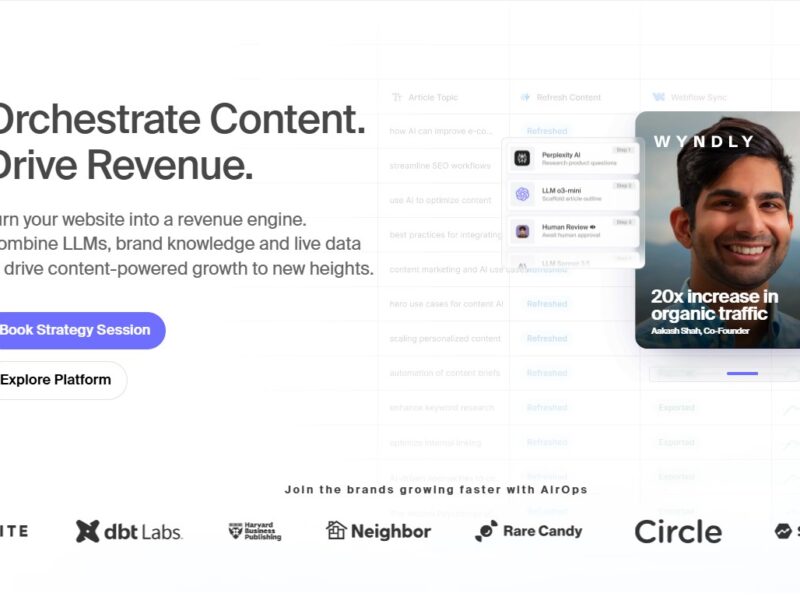
AirOps
What is Airops?
Airops is an advanced AI-powered operational management platform designed to streamline and optimize business workflows. Airops provides businesses with a suite of tools powered by artificial intelligence to help manage operations, improve decision-making, and increase overall efficiency. With features that cater to a wide range of industries, Airops focuses on automating routine tasks, analyzing large datasets, and providing actionable insights to help organizations improve their productivity and bottom line.
Ideal for businesses of all sizes, Airops aims to simplify complex operational processes, reduce human error, and enhance decision-making through intelligent automation. By leveraging AI, Airops allows organizations to make smarter choices and implement efficient processes that save both time and resources.
Features
Airops offers a range of powerful features that help businesses enhance their operational efficiency through AI-driven solutions. Key features include:
-
AI-Driven Workflow Automation: Airops allows businesses to automate repetitive tasks, freeing up time for employees to focus on higher-value activities. This feature helps businesses optimize their workflow and reduce manual intervention.
-
Data Analytics & Insights: With advanced analytics tools, Airops processes large datasets and provides actionable insights that businesses can use to improve performance, customer engagement, and operational processes.
-
Predictive Analytics: Airops uses AI to forecast trends and outcomes, helping businesses anticipate challenges and opportunities. This predictive capability is particularly valuable for inventory management, supply chain optimization, and customer behavior analysis.
-
Intelligent Task Scheduling: Airops automates task scheduling based on business priorities, team availability, and deadlines. This ensures that resources are allocated efficiently, reducing bottlenecks and improving overall productivity.
-
Real-Time Reporting & Dashboards: Airops offers customizable dashboards that provide real-time access to key performance metrics (KPIs) across different business functions, making it easier for decision-makers to monitor and adjust operations on the fly.
-
Collaboration Tools: Airops includes features for team collaboration, such as real-time communication, task tracking, and file sharing, ensuring teams can work together seamlessly even across different locations.
-
Integration with Existing Tools: Airops integrates with popular software tools, CRMs, and enterprise applications (such as Salesforce, HubSpot, and Slack), ensuring businesses can consolidate their operations and leverage the tools they already use.
-
Customizable AI Models: Businesses can customize Airops’ AI models to align with their unique operational needs, whether for data analysis, customer service automation, or supply chain management.
Pros & Cons
Pros:
-
Enhanced Efficiency: By automating routine tasks and optimizing workflows, Airops helps businesses save time and resources, enabling employees to focus on more strategic activities.
-
AI-Powered Decision Making: Airops provides predictive analytics and insights that help businesses make smarter, data-driven decisions that enhance overall performance.
-
Scalable Solution: Whether you’re a small startup or a large enterprise, Airops can scale with your business needs, adapting to different workflows and growing data volumes.
-
Real-Time Reporting: The platform provides real-time insights and customizable dashboards, helping managers and decision-makers stay on top of performance metrics and make adjustments when needed.
-
Collaboration Features: Airops makes collaboration between teams easier by offering tools for task management, file sharing, and real-time communication, improving cross-functional efficiency.
Cons:
-
Learning Curve for New Users: While Airops is user-friendly overall, businesses that are new to AI-powered tools may experience a learning curve when implementing more advanced features, like predictive analytics or AI model customization.
-
Pricing for Smaller Businesses: Airops’ comprehensive feature set comes at a premium, which may be cost-prohibitive for small businesses or startups with limited budgets.
-
Dependence on Data Quality: Airops’ AI-driven features are heavily reliant on the quality and accuracy of the data provided. If the data is incomplete or incorrect, the insights and predictions may be inaccurate.
-
Complexity of Advanced Features: While the basic features of Airops are relatively easy to use, some of the more advanced functionalities, such as deep integrations and custom AI model training, may require technical expertise or additional training.
Use Cases for Airops:
Airops can be used across a variety of industries to streamline operations, enhance decision-making, and improve productivity. Some common use cases include:
-
Supply Chain Optimization: Airops helps businesses in manufacturing and retail sectors optimize their supply chain by predicting demand, managing inventory, and forecasting delays. This improves operational efficiency and reduces costs.
-
Customer Service Automation: Airops can automate customer service processes, such as responding to common inquiries, tracking service tickets, and routing tasks to the right agents, improving the customer experience and reducing the burden on support teams.
-
Marketing Campaign Optimization: By analyzing data from various sources, Airops can provide insights into customer behavior and campaign performance. Marketers can then use this information to tailor their strategies for better ROI.
-
Human Resources Management: Airops can help HR departments automate recruitment, employee training, and performance evaluations, ensuring that resources are used efficiently and recruitment processes are optimized.
-
Project Management: Businesses can use Airops to schedule tasks, track progress, and manage team resources effectively, ensuring that projects are completed on time and within budget.
Compared to Other Tools
When compared to other operational management and AI-powered platforms like Zapier, Trello, and Asana, Airops stands out for its AI-driven features and focus on automation and predictive analytics. Here’s how Airops compares to some of the other tools:
-
Zapier: While both tools help automate workflows, Zapier focuses on automating tasks between apps, while Airops provides a more comprehensive operational management solution, incorporating AI for predictive insights and real-time analytics.
-
Trello: Trello is a popular project management tool that allows teams to organize tasks and projects. However, Trello lacks AI-driven features and predictive analytics, which are key offerings of Airops. Airops offers deeper insights into operational data and can automate tasks beyond just project management.
-
Asana: Asana is a task management tool that helps teams track work. While it offers some automation capabilities, it lacks the deep AI functionality and advanced data analytics features that Airops provides. Airops also excels at integrating data from various sources to offer a more holistic view of operations.
In summary, Airops provides a more advanced AI-powered platform compared to many of the traditional project management or workflow automation tools, offering superior analytics, task automation, and real-time decision-making capabilities.
Airops is a comprehensive AI-powered platform designed to help businesses optimize their operations, automate routine tasks, and make data-driven decisions. With its advanced analytics, workflow automation, and predictive capabilities, Airops is well-suited for companies looking to streamline operations and enhance productivity across various departments, from supply chain management to customer service.
While its pricing may be a consideration for smaller businesses, Airops offers scalable, AI-driven solutions that provide significant value for medium to large enterprises. If you’re looking for an intelligent, data-driven platform to optimize your business operations and enhance decision-making, Airops is a strong contender.
FAQs
1. What industries can benefit from Airops?
Airops is suitable for businesses in a variety of industries, including manufacturing, retail, logistics, marketing, HR, and customer service. Its AI-driven features help optimize operations in many different business areas.
2. Is Airops easy to integrate with other business tools?
Yes, Airops integrates with a wide range of existing business tools and software, such as CRMs, project management platforms, and communication tools like Slack, making it easy to integrate into your current workflow.
3. Does Airops require technical expertise to use?
While the basic features of Airops are user-friendly, businesses that wish to take full advantage of its AI-driven analytics and customization features may require some technical expertise to get the most out of the platform.
4. How does Airops help with customer service automation?
Airops helps automate customer service processes by analyzing support tickets, responding to common queries, and routing tasks to appropriate team members. This reduces manual effort and improves response times for customers.
5. Can Airops be used by small businesses?
While Airops is suitable for businesses of all sizes, its pricing and advanced features are more aligned with medium to large businesses. Small businesses with limited budgets may find it more cost-effective to start with other tools before upgrading to Airops as they scale.