
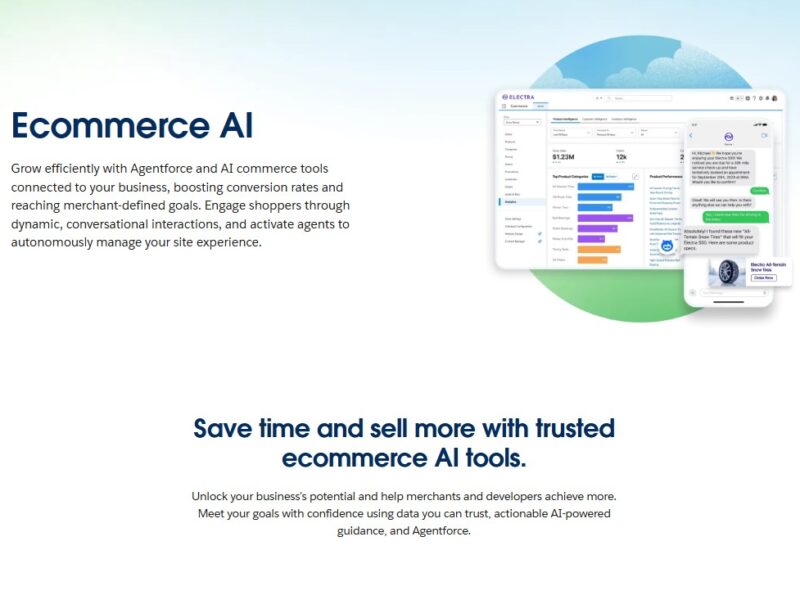
Ecommerce AI
What is Salesforce Commerce AI?
Salesforce Commerce AI is a suite of artificial intelligence tools designed to help e-commerce businesses improve customer experiences, streamline operations, and increase sales. Built on Salesforce’s robust platform, it uses machine learning, predictive analytics, and automation to optimize product recommendations, personalize shopping experiences, automate customer service, and improve inventory management. Essentially, Commerce AI enables retailers to leverage the power of data and AI to enhance every aspect of their e-commerce operations.
Features
Salesforce Commerce AI offers a variety of features that help businesses deliver tailored shopping experiences, improve operational efficiency, and drive growth. Here are some of its standout features:
-
Personalized Recommendations: By analyzing customer browsing and purchasing behaviors, Salesforce Commerce AI delivers highly relevant product recommendations in real time, enhancing the likelihood of conversion and increasing average order value.
-
Intelligent Search: The platform uses AI-powered search algorithms to ensure that customers find the products they’re looking for quickly, even when they don’t use the exact terms or spelling.
-
Predictive Analytics: Commerce AI helps businesses forecast customer behavior, demand, and trends, allowing for more informed decision-making and proactive inventory management.
-
AI-powered Customer Support: Salesforce Commerce AI enables chatbots and virtual assistants to offer efficient, 24/7 customer support, improving customer satisfaction and reducing operational costs.
-
Automated Merchandising: With AI-driven product curation, businesses can automatically adjust and optimize product displays based on customer preferences, seasonal trends, and inventory levels.
-
Dynamic Pricing: By analyzing competitors’ pricing, customer demand, and market conditions, Commerce AI helps businesses adjust prices dynamically to remain competitive and maximize revenue.
Pros and Cons
Pros:
-
Increased Personalization: The ability to provide tailored product recommendations enhances the overall customer shopping experience and drives higher engagement.
-
Data-Driven Decisions: Predictive analytics and AI-powered insights empower businesses to make more informed decisions about inventory, marketing, and sales strategies.
-
Enhanced Customer Support: AI-driven chatbots and customer support tools reduce response times, offering better service around the clock and improving customer satisfaction.
-
Automation of Repetitive Tasks: By automating merchandising, pricing, and inventory management, businesses can reduce manual effort and increase operational efficiency.
-
Seamless Integration with Salesforce Ecosystem: Since Salesforce Commerce AI is built on the Salesforce platform, it integrates seamlessly with other Salesforce products such as Marketing Cloud, Service Cloud, and Sales Cloud, providing a unified customer experience.
Cons:
-
High Initial Cost: While Salesforce Commerce AI offers a wealth of features, it can be a significant investment, especially for smaller businesses with limited budgets.
-
Complexity of Implementation: Integrating AI into existing e-commerce operations may require expertise, making the setup and implementation process more complex for businesses without a dedicated IT team.
-
Dependence on Data Quality: AI algorithms rely on high-quality, clean data to provide accurate insights and predictions. If the data fed into the system is flawed, the results may not be reliable.
-
Learning Curve: There is a learning curve associated with using Salesforce Commerce AI to its full potential. Businesses may need time to familiarize themselves with the platform’s full range of features and capabilities.
-
Customization Limitations: While Salesforce offers powerful AI tools, some businesses may find that the platform lacks the level of customization they need for highly specialized use cases.
Use Cases for Salesforce Commerce AI:
Salesforce Commerce AI is ideal for businesses of all sizes that want to leverage AI to improve their e-commerce operations. Here are some typical use cases:
-
E-Commerce Personalization: Retailers can use Commerce AI to create personalized shopping experiences, offering product recommendations based on customer preferences and previous behavior.
-
Inventory Management and Demand Forecasting: AI can help businesses predict which products will be in demand, ensuring that they have the right stock levels at the right time.
-
Dynamic Pricing Optimization: Retailers can use AI to monitor competitors’ prices and adjust their own prices in real time, ensuring they stay competitive in the market.
-
Customer Service Automation: Businesses can implement AI-powered chatbots to handle common customer queries, freeing up customer support teams to focus on more complex issues.
-
Targeted Marketing Campaigns: Salesforce Commerce AI can analyze customer behavior to help marketers create more targeted and effective marketing campaigns, improving conversion rates and ROI.
Salesforce Commerce AI Compared to Other Tools
Salesforce Commerce AI stands out in the crowded AI-powered e-commerce space thanks to its deep integration with the Salesforce ecosystem, which allows for a seamless flow of data between marketing, sales, and customer service. However, it is important to compare it to other leading e-commerce AI tools to better understand its strengths and limitations.
-
Shopify Plus: While Shopify also offers AI-powered tools for product recommendations and personalization, Salesforce Commerce AI offers more advanced predictive analytics, dynamic pricing, and deeper integration with CRM and service tools. Salesforce’s focus on automation and cross-channel integration makes it more powerful for larger enterprises with complex needs.
-
Adobe Sensei: Adobe Sensei provides AI capabilities for personalization, search, and customer insights, but Salesforce Commerce AI is more focused on end-to-end e-commerce optimization, integrating more seamlessly with a full suite of CRM, marketing, and sales tools.
-
Dynamic Yield: Dynamic Yield offers personalization and A/B testing features, but Salesforce Commerce AI provides a broader range of capabilities, including predictive analytics, automated merchandising, and AI-powered customer service.
Ultimately, Salesforce Commerce AI is better suited for businesses that need a comprehensive, integrated solution for e-commerce optimization and are already using Salesforce’s broader ecosystem.
Salesforce Commerce AI is a powerful tool that can help e-commerce businesses optimize their operations, deliver personalized customer experiences, and drive more sales. Its advanced features, including predictive analytics, intelligent search, and automated customer support, make it a top choice for companies looking to stay competitive in the fast-evolving e-commerce landscape. However, the platform’s complexity and cost may be a consideration for smaller businesses or those without an existing Salesforce ecosystem.
If you’re looking to take your e-commerce business to the next level with AI-driven insights and automation, Salesforce Commerce AI offers a comprehensive, scalable solution that can deliver significant value.
FAQs
1. What types of businesses can benefit from Salesforce Commerce AI?
Salesforce Commerce AI is ideal for businesses of all sizes, particularly those already using Salesforce products. It is especially beneficial for large enterprises that need advanced e-commerce capabilities, including personalized product recommendations, dynamic pricing, and customer service automation.
2. How does Salesforce Commerce AI improve customer experience?
Commerce AI personalizes the shopping experience by recommending products based on customer behavior and preferences. It also provides faster search results and 24/7 customer support through AI-powered chatbots, enhancing overall satisfaction.
3. How easy is it to integrate Salesforce Commerce AI into my existing e-commerce platform?
The integration process can be complex and may require technical expertise, particularly for businesses that do not already use Salesforce. However, for businesses already within the Salesforce ecosystem, integration is more seamless.
4. What are the main differences between Salesforce Commerce AI and other AI tools like Adobe Sensei?
Salesforce Commerce AI is more focused on e-commerce optimization, offering tools for product recommendations, pricing, and merchandising, whereas Adobe Sensei is primarily used for marketing and creative assets. Salesforce’s integration with its broader CRM and service tools provides a more comprehensive solution.
5. Does Salesforce Commerce AI require a large investment?
Yes, Salesforce Commerce AI is a premium solution and may be a significant investment, particularly for smaller businesses. The cost is justified by its advanced features and the potential to drive significant revenue growth for larger enterprises.